Waveform, vectorscope and diagnosis for ST 2110 video, audio and ANC
Full-resolution picture with scopes. Meters for every audio stream. Timecode and captions from the ANC. When something is off, the diagnosis shows the root cause first.
Personal $49€45495 kr, Team $199€1791 995 kr a month. No card needed for the trial.
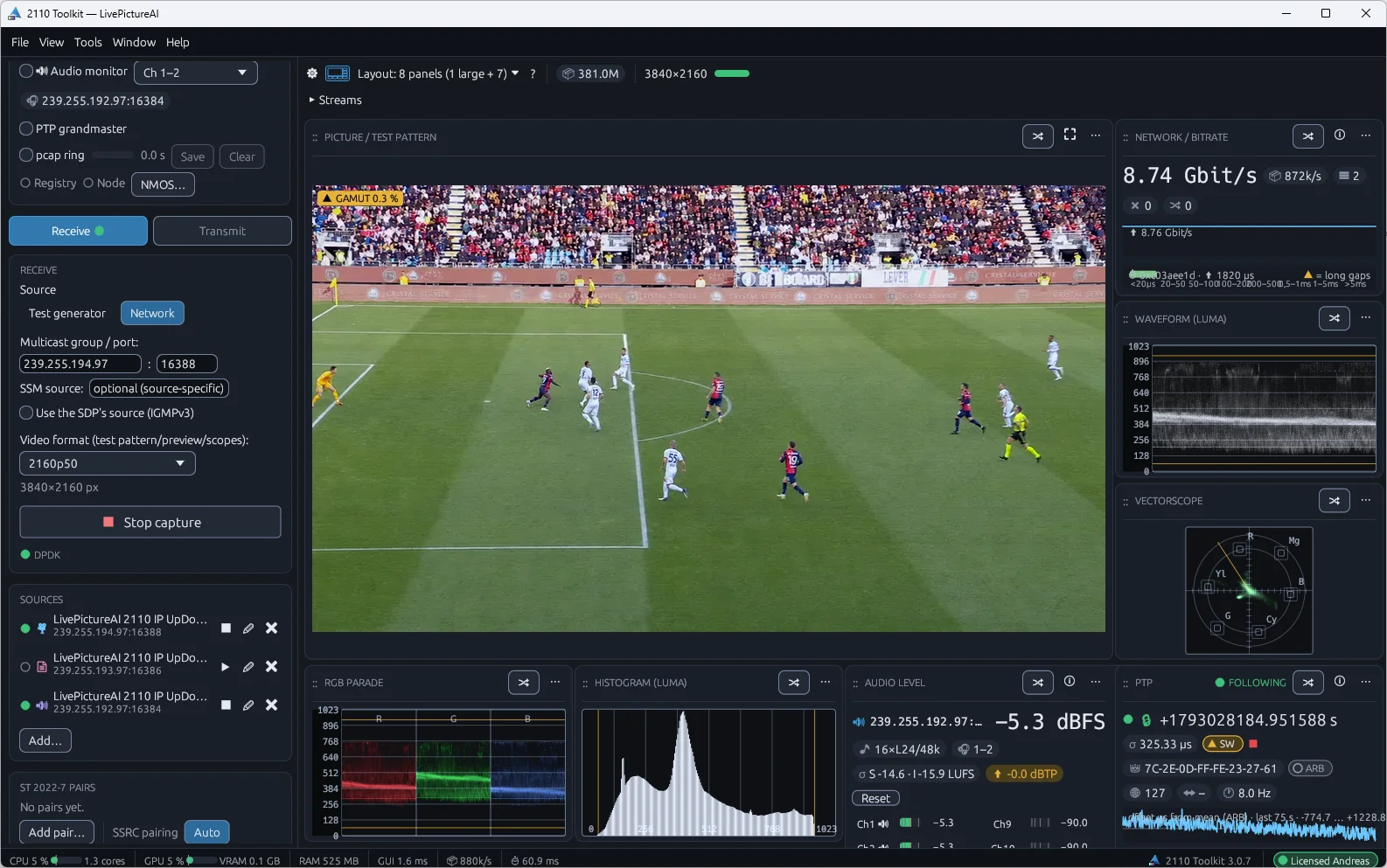
- ST 2110-20, -30, -31 and -40
- Waveform, vectorscope, RGB parade and histogram
- 10-bit pixel inspector
- EBU R128 loudness and true peak
- Timecode, captions, AFD and SCTE-104
- Up to 4K on one 10/25 GbE card
Picture, scopes and network health for every stream
Analyze: receive and inspect
- Video, audio and ANC for ST 2110-20, -30 and -40. Up to 4K via DPDK on an Intel X550 (10 GbE) or NVIDIA ConnectX-6 Dx (25 GbE). 1080p on a standard Windows NIC
- Blackmagic IP10 for 4K over 10 GbE
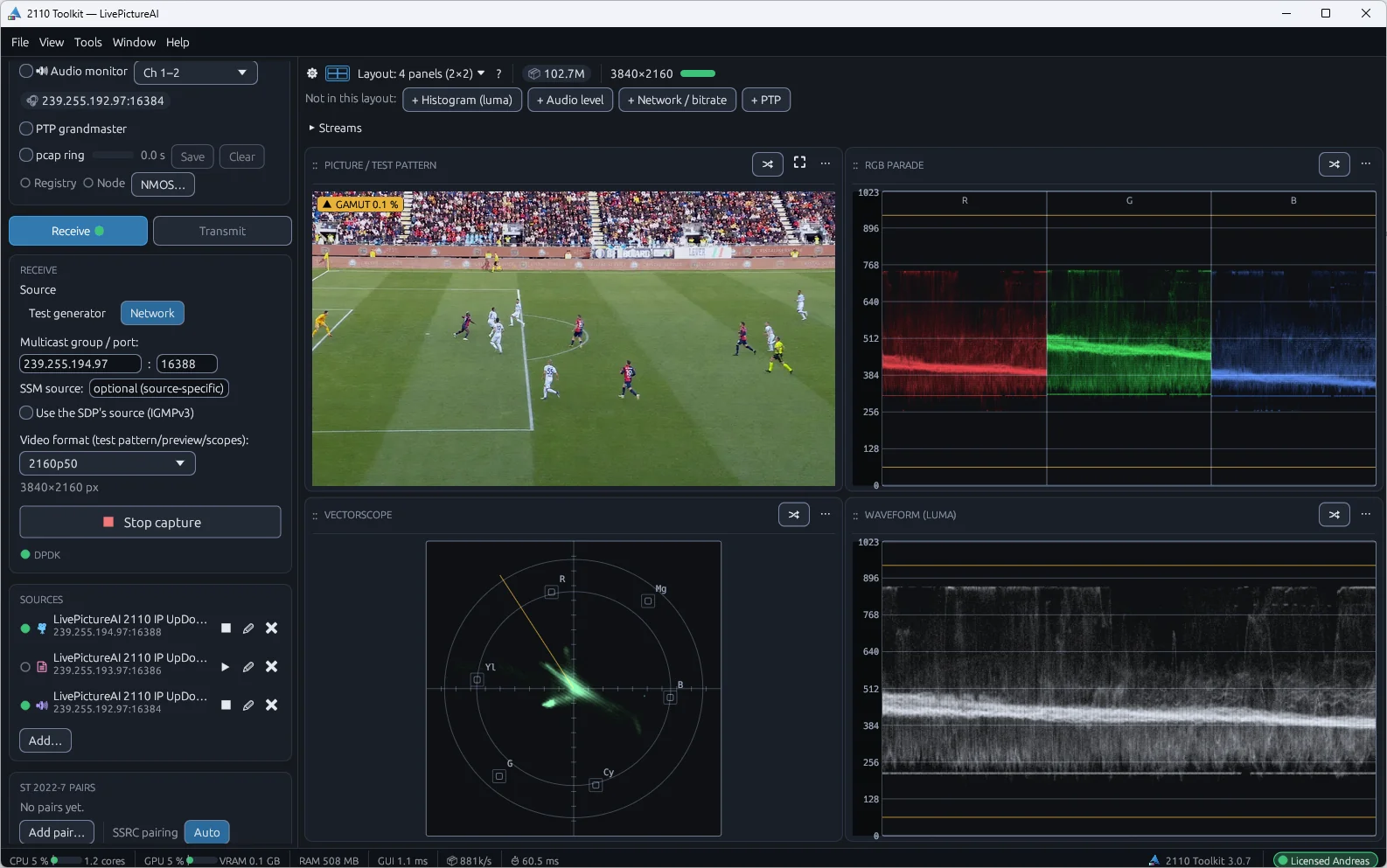
- Full-resolution picture on the GPU. Waveform, vectorscope, RGB parade, histogram and a 10-bit pixel inspector
- Freeze, black and gamut alerts catch a stuck or clipped source
- Multiviewer: up to 36 streams, named from NMOS, with alarm borders and audio meters
- Audio levels for every stream. EBU R128 loudness, true peak, correlation and Lissajous
- Timecode, captions (CEA-608/708 and OP-47), AFD, SCTE-104 and VPID, live from the ANC
- Bitrate, loss, reordering, packet-interval histograms, ST 2110-21 timing and NIC drops per stream
- An in-memory pcap ring that opens in Wireshark, plus recording on alarm
Every channel, every caption, every timecode
Every audio stream at once
Level meters for all audio streams, not only the one you hear. EBU R128 loudness and true peak for the monitored pair. Channel names come from the SDP's channel order, such as L, R, C and LFE.
ST 2110-31 (AES3)
Detects Dolby E and other SMPTE 337 data. Checks channel status, CRC and the V bit.
Timecode
Live timecode from the ANC stream, checked frame by frame and against PTP time. An alarm fires when it jumps or stands still.
Captions
CEA-608, CEA-708 and teletext (OP-47), with full national character sets. Read them in the app or over the picture. An alarm fires when captions stop.
AFD, SCTE-104, VPID and metadata
AFD in plain words, such as "pillarbox 4:3 in 16:9", checked against the picture. SCTE-104 ad signals go to the event log. VPID in plain words, compared with the SDP. Audio and HDR metadata when present.
The app tells you what's wrong
Most analyzers show hundreds of measurements and leave the conclusion to you. 2110 Toolkit checks the whole chain and tells you what is most likely wrong, why, and what to do.
The diagnosis checks the network card, multicast, PTP, NMOS, the stream description (SDP), loss and timing, and the picture itself. The root cause comes first. If the network card drops packets, that sits on top, with the loss and broken frames it causes below. Every finding has a plain-English explanation, the measurements behind it and suggested fixes.
Start it from an alarm, a stream or an NMOS receiver. Save the result as a report for a support ticket.
What's sent, not what's claimed
The app compares the sender's SDP with what arrives: resolution, frame rate, interlaced or progressive, channel count, channel order and packet time. SDP says 1080p50, the wire carries 1080i50? You see it at once.
Frame rate, resolution, black and freeze are measured on every video stream, not only the one you watch.
NMOS that matches reality
The app reads the NMOS registry and checks it against the network. It flags a sender that is off, a receiver tied to a sender that no longer exists, and a receiver on a different group than its sender.
Active tests
When measuring is not enough, the app tests, but only after you click. It sends a test stream through the network and checks it comes back. It rejoins a group and times the first packet. It compares loss with other streams from the same switch. It lists every PTP master it hears.
So you know if the fault is in the network, the source or the receiver.
AI that works from real measurements
Ask about your network in plain words. Answers build on the diagnosis, not on guesswork.
AI analysis in the app
Ask in plain words: "Why is the audio crackling on channel 3?" The answer builds on diagnosis data from your own network. It names the likely cause, the next step and what the app cannot see.
The AI never changes anything. It can suggest a test, ask for a frame or propose an NMOS reroute. You decide and act. You see exactly what is sent, and can hide addresses and names.
Connect your own AI assistant
The built-in MCP server lets Claude Desktop, Claude Code and other assistants read what the app sees and run the diagnosis. Ask "Why is the picture on CAM-3 black?" and get an answer from real measurements.
The assistant explains and suggests. It can never change devices, streams or settings. The server is off by default, local to your computer and needs a key. Tick a box and the app gives you a config to paste in.
Questions engineers ask
What does the 2110 Toolkit actually check?
What does the diagnosis do?
Can it read timecode and captions?
Why is there no audio when the video works?
Can I use it with Claude or another AI assistant?
What hardware do I need?
How do I get it, and what does it cost?
The full picture
This page covers one part of the 2110 Toolkit. The main page shows every part and compares the plans.
Try it on your own network
LivePictureAI SMPTE 2110 Toolkit is available today. Monthly subscription, cancel any time. Not sure it fits your network? Start a 14-day trial. Your key arrives by email straight away, no card required.
Personal
One engineer, two computers.
plus VAT where applicable
- Full analyzer: picture, scopes, audio, captions and network
- Diagnosis that puts the root cause first
- ST 2022-7, ST 2110-21 timing and lip sync
- Multiviewer with 4 tiles, recording on alarm and HTML reports
- AI analysis, 100 questions a month, and a read-only MCP server
- PTP monitor, grandmaster and NMOS controller
- Signal generator with mp4 playback, plus Blackmagic IP10
Team
Up to 5 users, 10 computers.
plus VAT where applicable
- Everything in Personal, for up to 5 users on 10 computers
- Multiviewer with up to 36 tiles
- Long-term recording to disk with file rotation
- Remote probes with REST API and alarms to syslog, webhooks and SNMP
- Priority email support
Enterprise
Larger teams and custom deployment.
- Volume seats across sites or facilities
- Deployment and onboarding support
- Direct line to the LivePictureAI team
Compare every feature, plan by plan
Request a trial and we email you the 14-day key and the download link. Enter the key on the download page to get the installer. Then activate it in the app.
Get in touch
Start a trial, ask a product question or request a feature. We follow up by email.